
Suisun City Previous Residents Sources
A one-address history needs sources that answer different questions. The Recorder follows recorded parties and legal transfers. Reverse directories and census schedules bring in occupants and households. A Sanborn sheet supplies a building snapshot, while permits record an activity at a date. The coverage table keeps those roles separate before a search begins.
| Source | Years It Covers | Where Held | What It Shows |
|---|---|---|---|
| Solano Recorder computer index | 1955-present | Recorder online index and office | Recorded parties, document type, date, and identifier |
| Earlier deed books and indexes | 1850-1954 | Recorder Research Area; County Historical Records request | Grantor, grantee, legal description, and recorded chain |
| R.L. Polk & Co. checks | 1963, 1968, 1973, 1977, 1982, 1987 | Official City study; SCGS or local library inquiry | Historical address and occupant checks |
| Cole cross-reference checks | 1992, 1995, 1999, 2003, 2008, 2013 | Official City study; SCGS or local library inquiry | Reverse or address-oriented occupant evidence |
| Federal census schedules | 1850-1950 | NARA, FamilySearch, or library databases | Households at an enumeration date |
| Suisun Sanborn map | March 1907, eight sheets | Library of Congress and local historical records | Footprint, material, use, and street context |
| City permit records | Portal coverage not officially located; monthly 2022 reports verified | Suisun Building Division and permit channels | Point-in-time work, parcel, applicant, owner contact, and contractor data |
Start with the era you need. For a recent transfer, use the online index and a copy request. For earlier ownership, plan for office research. For who lived at an address, pair a verified directory or census date with the deed chain instead of treating the owner as the whole household.
Find Suisun City Past Residents
The first task is to identify the parcel, not a person. Use the official Solano property search or the County GIS viewer with the street address or APN. The assessor accepts address and parcel routes, but public owner-name posting is restricted by California Government Code §7928.205. The online property card is therefore a location tool, while direct ownership questions belong in the Assessor Research Area.
Keep the situs address, mailing address, and legal description distinct. Situs tells where the parcel lies. A mailing address can point somewhere else, and a legal description or APN can remain useful when a postal label, street name, or city boundary changes. The working trail is simple: address → APN → owner clue → acquisition deed → earlier grantor.
Trace Suisun City Previous Residents
The Recorder's official-records index is keyed to grantor and grantee names, not a street-address field. That quirk makes the current parcel and owner clue important. Search results can identify a party, document type, recording date, and document number, but the deed image or copy is what ties the transfer to the legal description. A same-name hit is not enough.
- Pull the current APN and situs from the Assessor or GIS route, and note the exact parcel number.
- Search the current owner or grantee in the Solano official-records index for the likely acquisition period.
- Order or inspect the deed. Copy the grantor, grantee, legal description, APN, recording date, and document number.
- Search the seller or grantor as an earlier grantee. Repeat the name-to-name walk through each prior instrument.
- At the 1955 cutoff, move from the computer index to the Recorder Research Area for earlier books and indexes.
- Compare the ownership chain with Polk, Cole, census, obituary, cemetery, or permit evidence before calling anyone a past occupant.
- Grantor
- The party transferring or releasing an interest in the recorded instrument.
- Grantee
- The party receiving the interest named in the instrument.
- Chain of title
- The linked sequence of recorded transfers used to follow a parcel through earlier owners.
- Legal description
- The formal parcel description that can identify land more reliably than a changing street label.
The Recorder copy instructions show the current copy route. A copy request can be based on document type, party name, recording date, document number, or book and page.
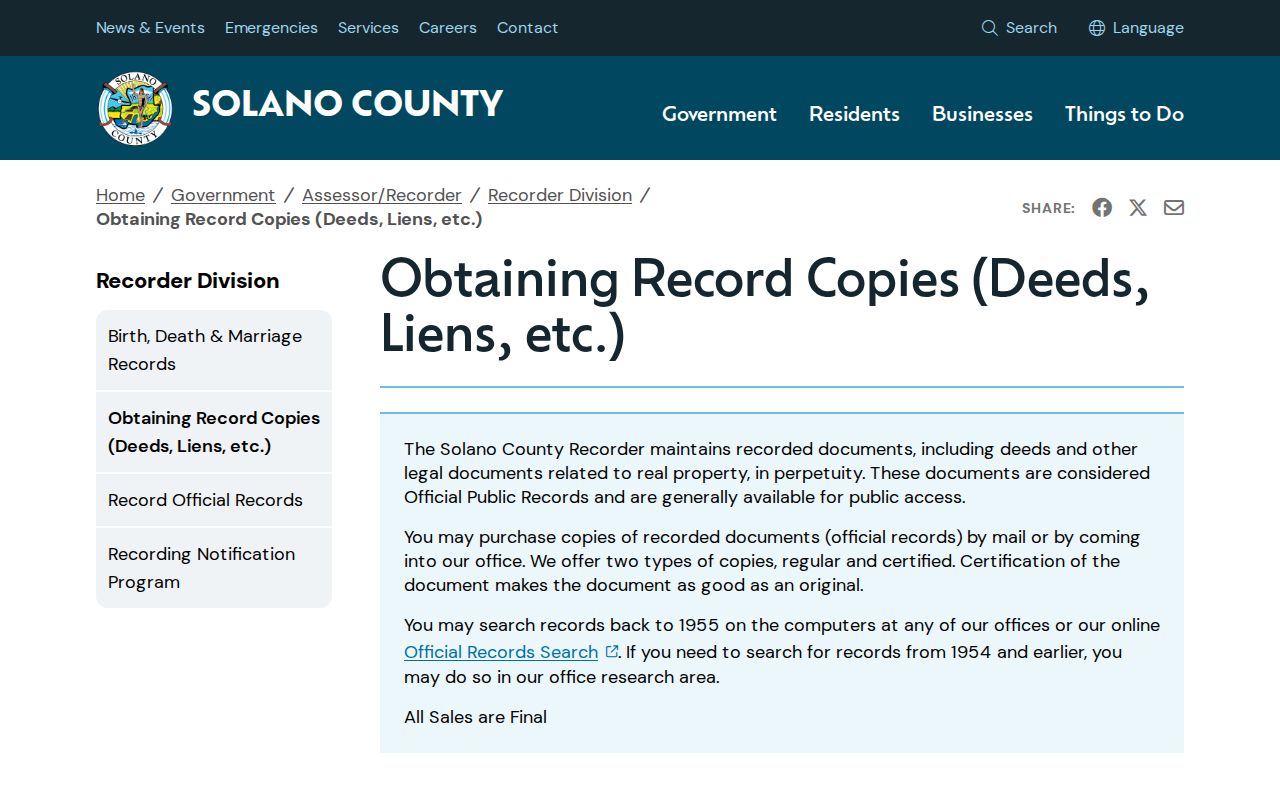
The image belongs to the deed-copy channel, not to a claim about a particular Suisun City parcel. It is a reminder to preserve the document identifier and legal description when a prior owner is found.
Suisun City Deed Chain Before 1955
The Recorder computer search reaches 1955. Instruments from 1954 and earlier require the office research area at 675 Texas Street, Suite 2700, Fairfield. The research area is open Monday through Friday from 9 a.m. to 4 p.m.; 707-784-6290 is the procedural phone channel. Older deed books and indexes are an in-person research task, not a gap to bridge with a guessed owner.
For a copy, the current schedule is $9 for the first page, $1 for each additional page, and $5 for certification. Mail requests should include document title or type, party names, document number or book and page, recording date, return details, payment, and a self-addressed stamped envelope. The office does not email recorded documents. When a search reaches the county's historical holdings, County Historical Records is a request channel for naturalization, probate, Sanborn, and other material dating from 1850.
Suisun City Walters Road Evidence
Walters Road is a useful test for how previous residents evidence can be discontinuous. The official City address study reports no Walters Road entry in the checked 1963 and 1968 Polk volumes. It reports Walters Road in the 1973, 1977, 1982, and 1987 Polk checks, followed by the 1992, 1995, 1999, 2003, 2008, and 2013 Cole checks.
Use that sequence as evidence for when the checked address record begins, not as proof of a street's exact creation date. A name may be absent because an edition was not checked, an address was indexed another way, or the record was not legible. The safest backward trail keeps the edition, page, street heading, number, and any APN or legal-description clue together.
Suisun City Past Households
Deeds tell who held a recorded interest. Directories and census schedules can show who was listed at an address. The confirmed Polk and Cole years are the address checkpoints, while federal population schedules through 1950 provide household snapshots. The historical volumes themselves are described on the Suisun City city directory page; the backward address task is to use one entry at a time.
- Pick a known address and a verified directory year. Copy the street heading, number, occupant or business, and page.
- Check the next available directory year in the same way. Mark a move, a name change, or an absence without assigning a cause.
- Pair the closest directory evidence with the 1950 census or an earlier census schedule. Compare household members and place at the census date.
- Set the household result beside the deed chain. An owner can differ from an occupant, and an address can have more than one household over time.
- Use probate, an obituary, or a cemetery record to close a trail when a person dies or leaves a public estate clue.
That process can identify a documented household at a point in time. It cannot prove that every person who stayed there was listed, or that a later name was related to an earlier one. Previous residents research is strongest when each claim carries its own date and source type.
Suisun City Previous Residents in Maps
The Library of Congress catalog for the March 1907 Suisun Sanborn map describes an eight-sheet local map. Its footprints, materials, uses, and nearby streets can test whether an address had a mapped structure at that moment. The map does not name every resident, so it belongs beside a directory, census, or recorded instrument.
A map is especially helpful when a later address label makes an old search hard to read. Compare the sheet, block shape, street name, and building outline, then retain the uncertainty if the match is not exact. The County Historical Records collection also lists Sanborn material among its records from 1850, creating a local request path when the online sheet is not enough.
Lawler House and Suisun City History
The Lawler House was built in 1857 and moved by truck and barge in 1979 to Old Town. That local story makes a hard point about address history: a building's story, a parcel's legal chain, a mailing label, and an occupant trail are not always the same story.
Permit records can add a point-in-time check for construction or alteration. The Suisun City Building Department links the current Tyler EnerGov portal and a permit-history channel. Published monthly 2022 reports can show activity or permit number, APN, site address, work description, owner or applicant contact, contractor, valuation, fees, and inspection area. Those fields describe the activity as recorded on that permit. They do not certify a current occupant or prove that a moved building stayed on the same parcel.
Suisun City Previous Residents Endpoints
When a past resident dies, probate can connect a name to a public estate trail. Solano Superior Court probate at the Hall of Justice, 600 Union Avenue, Fairfield, uses public petitions, wills, notices, and later distribution documents. The clerk's number is 707-207-7341. A public probate filing may name a decedent, petitioner, heirs, and service addresses, but a will alone is not proof of a later residence.
The Solano obituary and newspaper request service searches from an exact event date through two weeks afterward. The form asks for requester details, event category, subject name, date, city or location, and optional clues. Search and emailed PDF delivery are free; printed or mailed copies cost $0.20 per page.

The image shows an access route for an obituary clue, not a public name list. Exact date and place details help staff search the Fairfield-Suisun microfilm network when a newspaper is uncertain.
Rockville Cemetery opened in 1853, and the Suisun-Fairfield Cemetery is another local endpoint. Newer cemetery records were being entered into an internal or online database from 2023 while paper records remained in a fireproof vault. No public interment search URL was verified, so a focused cemetery inquiry is safer than an assumed result.
The Solano County Historical Society is a further local-history contact for programs and historical context.
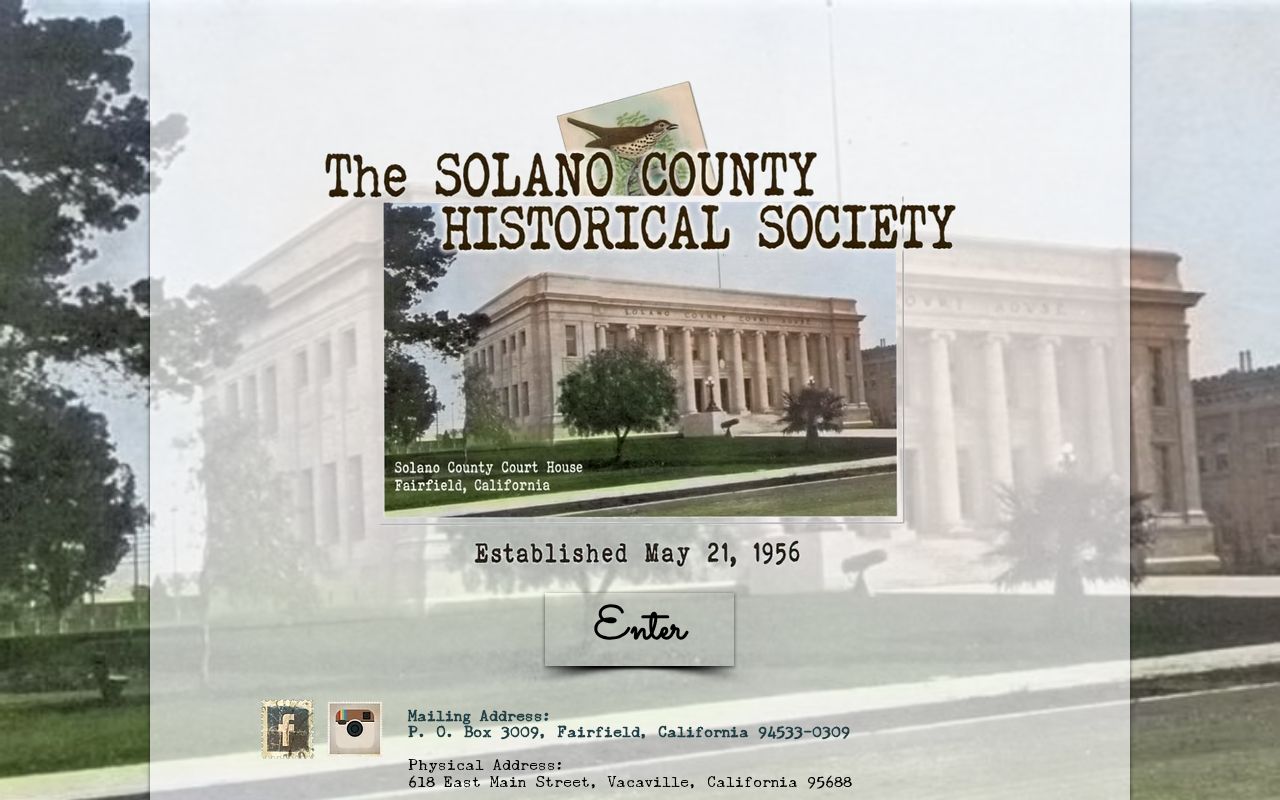
The historical society image belongs to the context layer. It can help frame a house story, while the Recorder, court, cemetery, or library custodian remains the source for a specific record.
Suisun City Owner Versus Occupant
Every previous-resident conclusion should name the record role. The previous residents trail is strongest when each claim carries its own date. An owner is a recorded property interest holder. An occupant is a person listed at an address in a directory or census. A permit owner contact is the party tied to that activity at that date. A mailing address is where notices go. None of those labels automatically proves who lived in the home.
Keep source copies, dates, document numbers, edition names, and page references in private research notes. If a living person appears in a record, limit the work to a lawful personal purpose and avoid publishing a location trail.
Lawful house history. Previous residents research is appropriate for family history, a property story, or personal curiosity. Do not use names or addresses to follow, threaten, harass, or harm a living person; California Penal Code §646.9 and Code of Civil Procedure §527.6 address stalking and civil harassment.
That boundary protects the value of a careful address history. A recorded deed, a census household, a directory entry, and a map can each be useful without being turned into a claim that the sources cannot support.